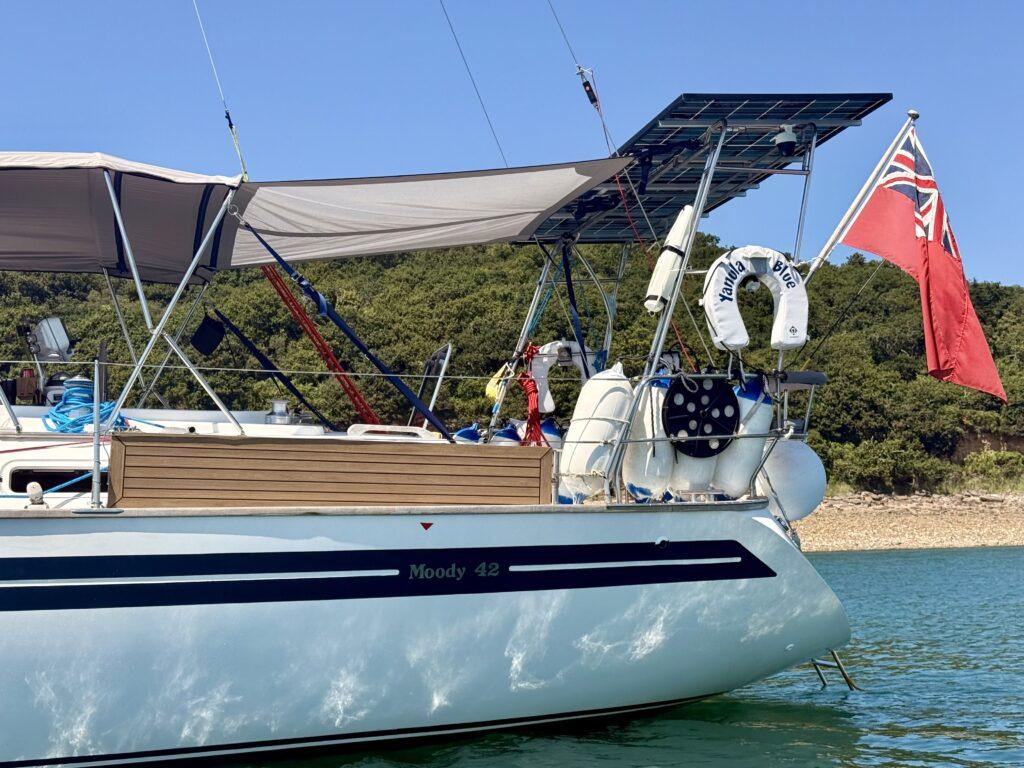
Our intention has always been to be as self sufficient as possible and we knew that power generation would be one thing we would need to solve.
Solar, wind and hydro versus fossil fuels
Many blue-water cruising boats would be equipped with a generator and religiously run the generator for an hour or so a day to recharge their battery bank, however, with the development of solar panels and the ability to store energy more effectively with Lithium Iron Phosphate battery technology, we were keen to look into a system that would allow us to live off grid without burning fossil fuels.
On our last boat we had a wind generator which was handy for topping up the battery for lighting and some use of the fridge, but it did not give us enough power to really live on and over the course of our ownership of Sansovino, we learnt that they are generally noisy. The constant whir when the wind blows, particularly overnight at anchor did not make for a great nights sleep. Jenni once caught her thumb in it too. Ouch!
So as we did our research we came across Ian Cunningham. Ian is the MD of Cunningham Marine and a self confessed nerd when it comes to designing and implementing solar systems on boats. He has his own boat and lives off grid, so has first hand experience too.
What we took out
There were, of course, some existing systems onboard when we first bought Yanula Blue. She had an isolation transformer, 2 lead acid house batteries and an inverter. The existing systems worked, but the batteries were shot and needed replacing and we did not have a lot of faith in the inverter so we replaced everything.
We also suspected we might have enough power to cook using electricity and remove the gas system altogether. The benefits of achieving this would be safety, as escaped gas sinks to the bottom of the boat if it leaks and replacing gas bottles in varied countries can be problematic as there are so many different bottle fittings. We built this question into our specification and Ian responded, giving us the confidence that with the right amount of solar we could remove the gas. So with that in mind we removed the old gas cooker and sold it on ebay.
Phase one – the install
Over the winter of 2024 we had completed the work on the hull and internal pipework in Portland and our friend Rob Hescroff helped Chris move Yanula Blue to Cowes where she was booked in for the electrical work. It was a very cold day and we nearly froze Rob on the sail across to Cowes. Ian set to work and installed eight, one hundred amp hour, lithium phosphate batteries. The battery location needed to be relocated due to the quantity, as they would not fit in the space where the three house batteries were stored under the bed in the aft cabin. (see Upgrades in Carpentry for more information on how we encased the new batteries)
The system also incorporated a display unit and the Cerbo GX which is the brains of the system, enabling us to see power input and output across both 12 volt and 240volt systems. The Cerbo GX has many other facilities which will be the content of another post in the future. The isolation transformer was replaced and two MPPT ( Maximum Power Point Tracker) controllers installed ready to take the supply from solar panels. Finally there was an Orion DC to DC controller to manage the output of the excess energy derived from the engine’s alternator when motoring and feed it in to the house batteries.
Phase two – the solar arch
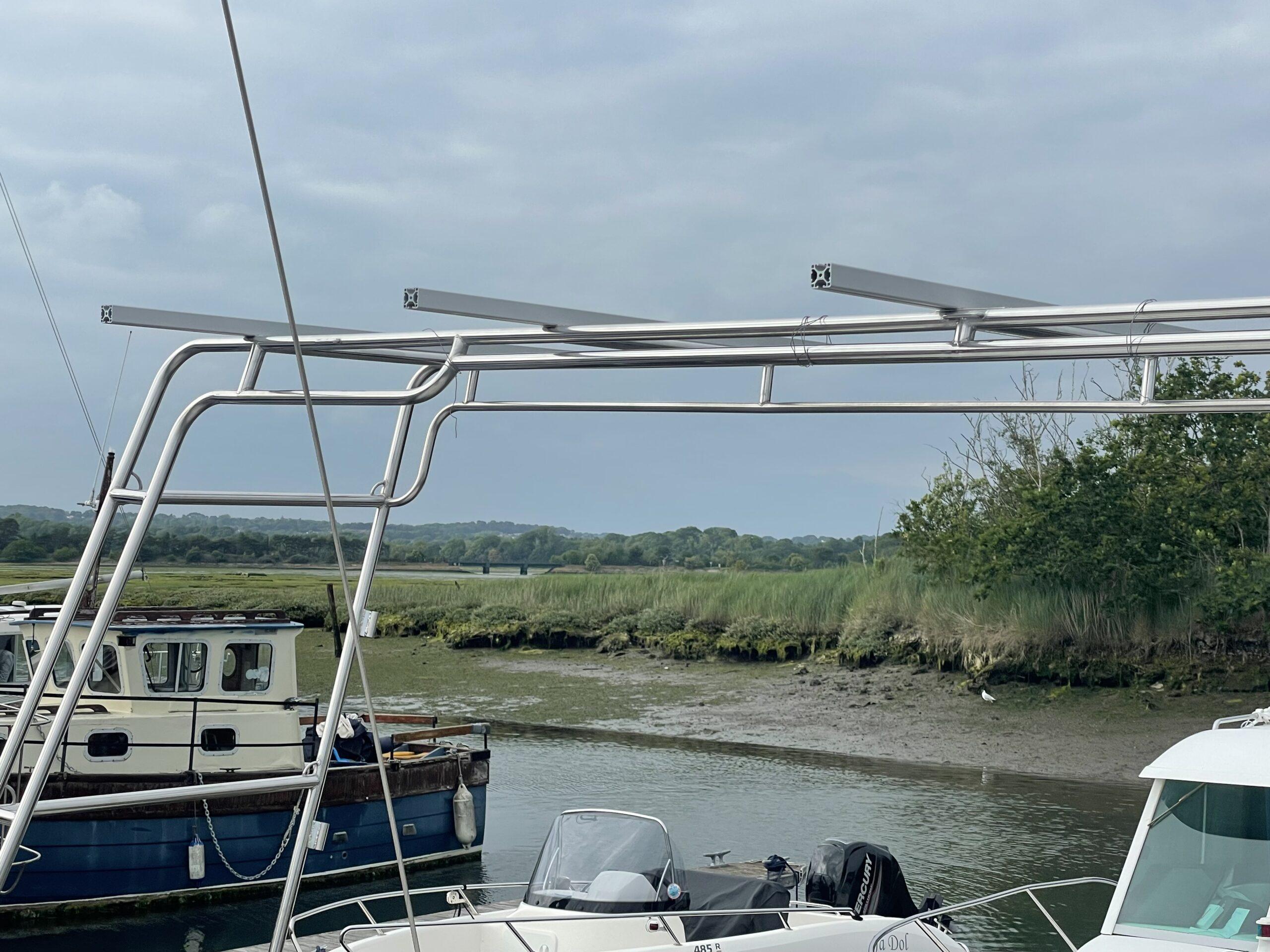
We had been chatting to Ian about a solar arch as well, however, when we got quotes against our specification, from a supplier Ian had found, we were dubious about their costing. The quotes were provided by a South Coast supplier who advertises a lot on Facebook and we thought they were excessively priced.
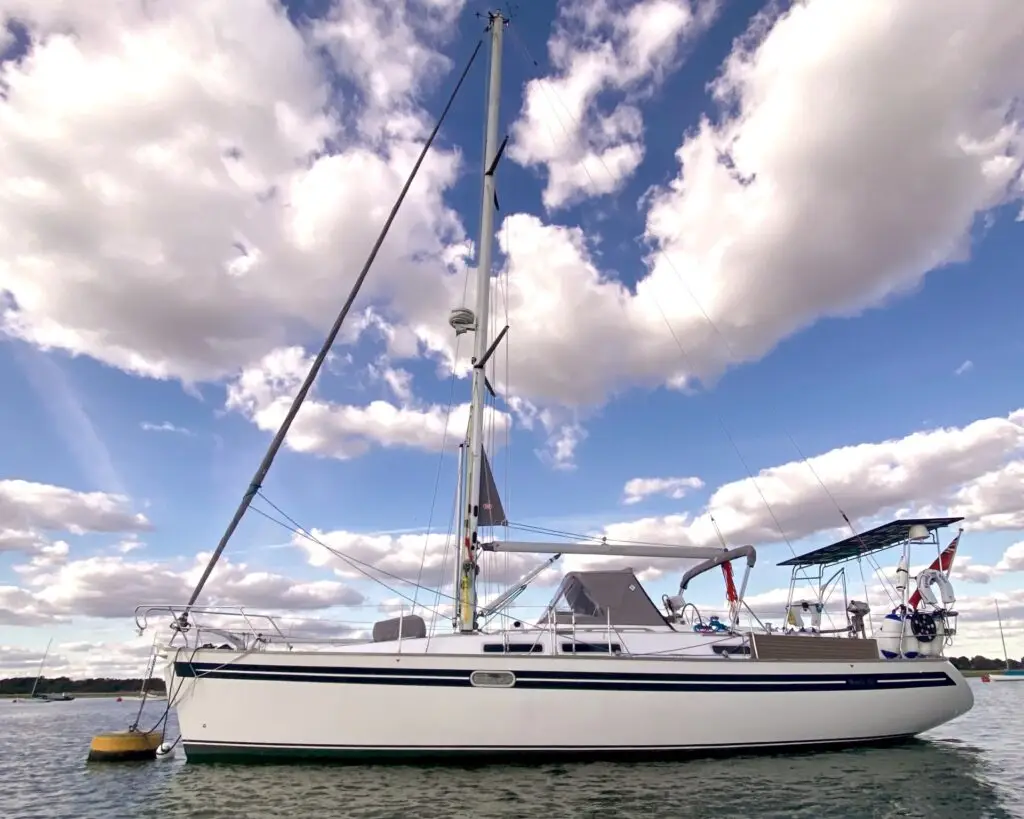
We eventually found a local engineer, Russ of RSL Welding, who we got to know well and he came to see us about a design. We were trying to alleviate as much weight as possible from the arch, so davits (arms that help hoist a dinghy up) were not specified. We eventually decided we would weld the arch onto the pushpit (the rails that surround the back end of the boat), so this required the pushpit to be removed and a template created so that we could replicate the pushpit configuration in the workshop.
Chris removed the pushpit and took it to Russ’ workshop and Russ set up a jig over the template to establish the structure of the arch and set about creating it.
Whilst we were in the design phase we had a small crane arm that we wanted to fit and we had discussed with Southern Sails, the manufacturer of our sprayhood and bimini, about having a sunshade made in a mesh that could bridge between the bimini and the arch. Russ, took the requirements and incorporated them in to the design.
Before long the arch was manufactured and Russ and his father brought the arch to Port of Poole Marina to fit it. It slid on wonderfully with a couple of cuts and two plates attached for extra stability when connected to the toe rail of Yanula Blue.
Once installed we realised the stability of the arch was a little too flexible, so we set about removing it again. The arch was returned to the workshop for a secondary section to provide transverse stability and after a few days back it came in its final form. It was perfect. Understated and ready for solar panels. We can’t thank or recommend Russ enough. His professionalism, design and general understanding of our requirements was fabulous. Here’s a link to his website.
Choosing panels
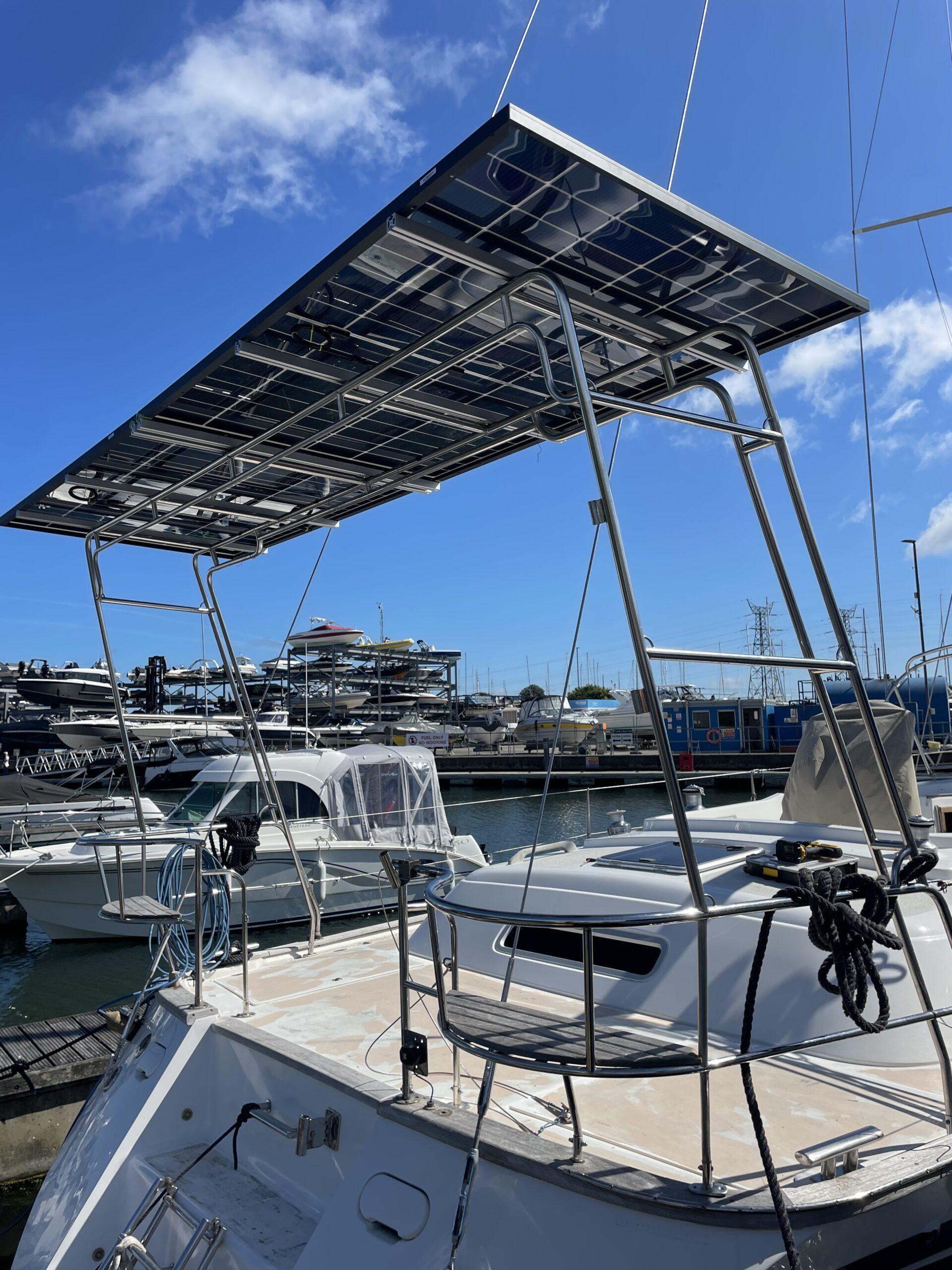
Ian of Cunningham Marine, had put us on to panels that he had used before and as we researched we saw the development of these panels come on immensely. Initially we had looked at two 410 watt output panels, but as we came to purchase them we saw that there were now 455 watt panels at the same size so we went for the bigger output and had them delivered. But how to fasten them on?
Further research revealed an extruded aluminium system that contains grooves that take a special nut and a bolt at the right length connected on. The system had end caps to the bars and so would look professional as well as the aluminium keeping the weight down. Our trusty friend Rob helped Chris fit the panels on the arch and they were ready to wire up.
Phase three – the final wiring.
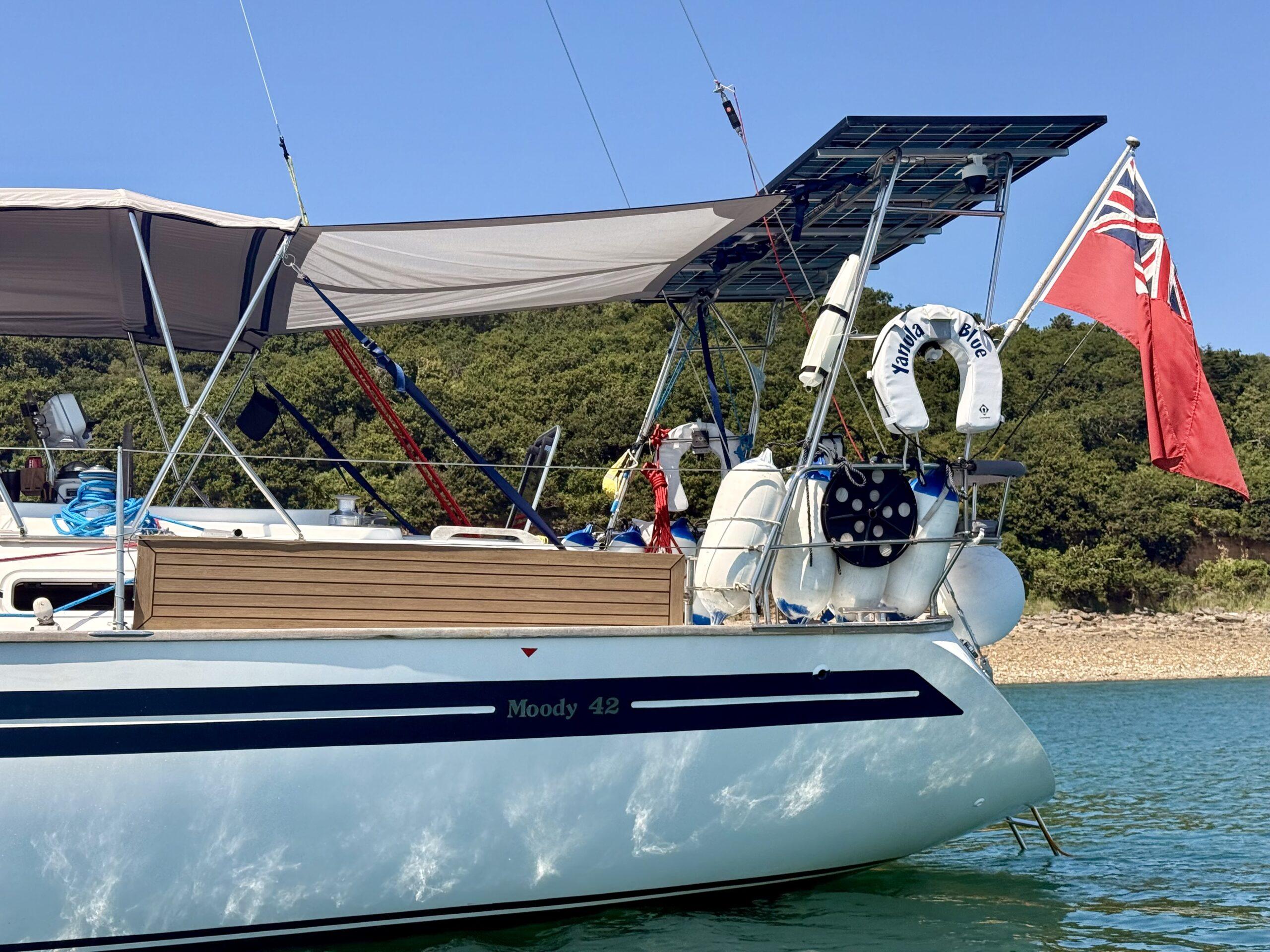
Ian came to the boat this time, we were berthed in Cobbs Quay Marina having the deck upgraded (see blog on upgrading the deck) The final piece of the puzzle was to wire in the panels and provide power to wire a light in that I had installed underneath the arch. Russ had provided mousing lines but the routing of the wiring inside was difficult as the diameter of the stainless tube we had used was slimmer than usual arches. I had noticed a couple of other issues in the wiring during the time we’d used Yanula Blue and Ian helped diagnose the issues including a dry joint in the new AIS aerial
The outcome
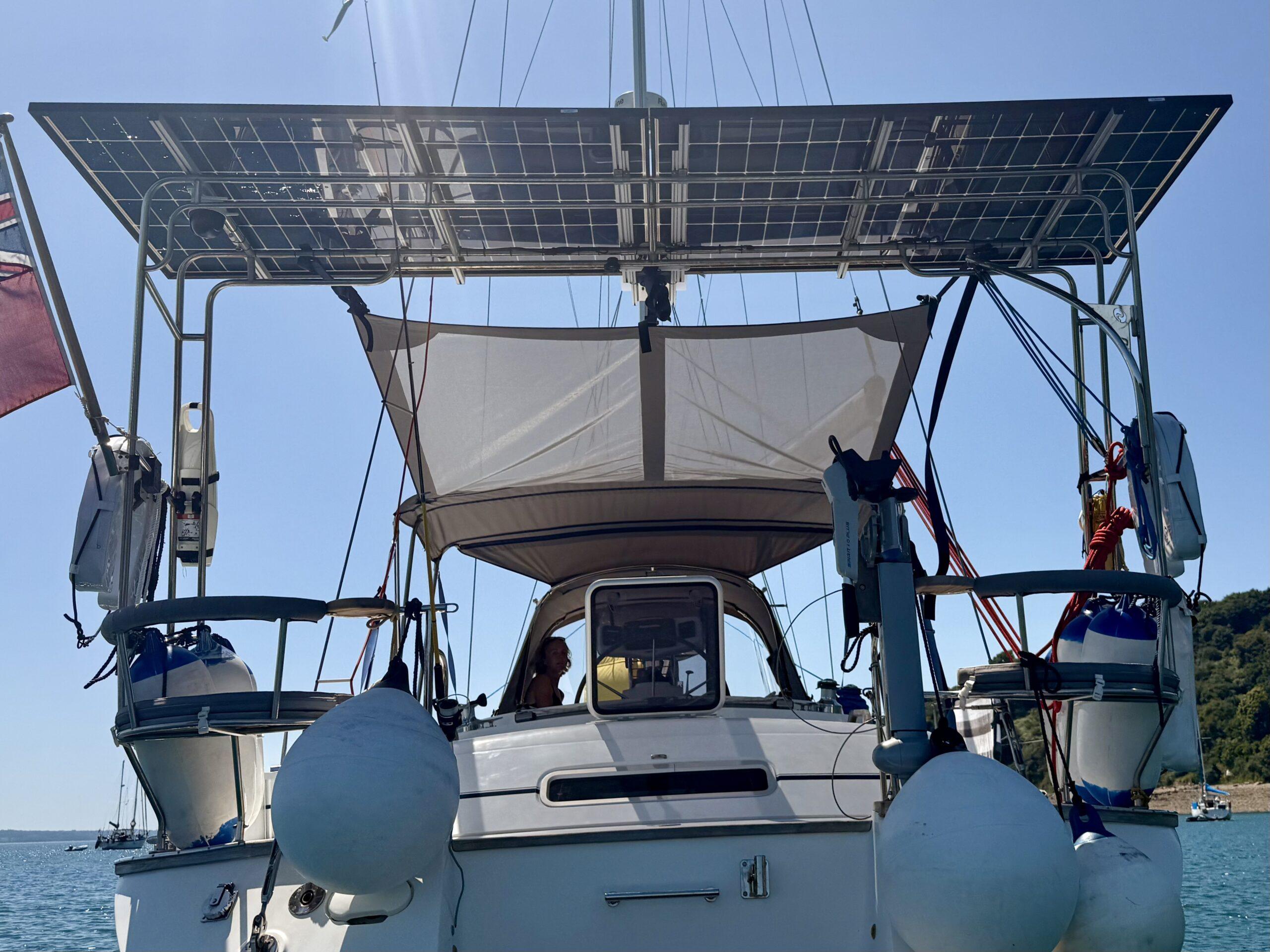
Eventually all was wired in and we had solar power! The completion coincided with the very sunny months we had in early ‘24 and the systems were great. The Victron system gives superb feedback on battery state of charge and the power input the solar panels are providing. We were using the heat gun and the hoover without the need to use shore power and so the system was as looking good.
The final piece of the puzzle was to replace the gas oven. We achieved this with a twin induction hob and an air-fryer oven. Marine electric ovens are very expensive, so Chris created a plywood housing that would work when gimballed (keeps level why the boat heels) and installed it ready to take the gadgets.
We’re still getting used to using all electric and we need to be careful we don’t overload the system, however in general we’ve always had loads of power and have got through the overcast days (less power generation though the panels) and been able to top up on the sunnier days. We’re even exploring a system that will eventually, automatically turn on the hot water when there is excess power.