As we sail this planet we’re presented with different challenges and by far and away the biggest challenge, and the one we monitor most closely, is which way is the wind going and how will it affect our plans to travel to a specific destination, hence the saying, “sailing where the wind takes us”
Sailors talk a lot about points of sail. You can look up points of sail here on the RYA website , but for ease on this page we’ll simplify it in to three below. To make this easier to understand let’s use a classic orientation where, when we refer to the angle of the wind, we’re meaning the angle relative to the boat’s direction.
Close Hauled
This is when we’re heading as close to the wind direction as we can get without going directly in to it (we can’t do that, physics says it impossible). We can get to about 35 degrees to the wind before the sails become inefficient, but only on a flat sea, any seaway that’s lumpy really needs about 40 to 45 degrees.
Beam Reach
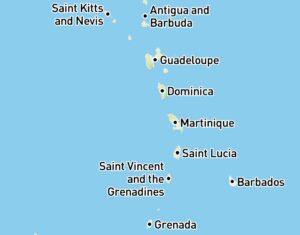
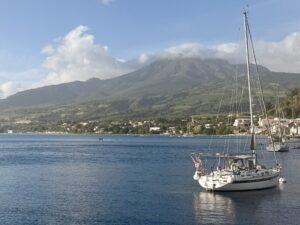
This is where the wind is blowing across the boat (across her beam) and so this will be where the wind angle is around 90 degrees to our chosen directon. Yanula Blue loves this and speeds ahead, we think she’s likely designed for this sort of sailing. This is the sailing we do in the Caribbean, as the islands are orientated North to South and the prevailing wind comes from the East, so it’s generally across our beam.
Broad Reach to Downwind
This is the sailing we do in the trade winds, it is where the wind is behind us from about 110 to 180 degrees (from behind the boat). As crossing the Atlantic East to West is generally trade-wind sailing, and we were doing it for a long time, we spent a while in Las Palmas getting our configuration right.
Size matters
Now we’ve spoken about direction, let’s introduce wind strength. Wind speed is measured in knots or using the Beaufort scale and for the physicists, the pressure exerted on the sails is shown below. The table below shows the increase in pressure through the Beaufort scale, the pressure increases quadratically, so if the wind speed doubles, the pressure is four times higher and if the wind speed triples the pressure is nine times higher.
| Beaufort | Wind Speed Range (kt) | Median (kt) | Wind Pressure (Pa) |
|---|---|---|---|
| 1 | 1–3 | 2 | 0.77 Pa |
| 2 | 4–6 | 5 | 4.79 Pa |
| 3 | 7–10 | 8.5 | 13.88 Pa |
| 4 | 11–16 | 13.5 | 34.94 Pa |
| 5 | 17–21 | 19 | 68.99 Pa |
| 6 | 22–27 | 24.5 | 114.91 Pa |
| 7 | 28–33 | 30.5 | 178.17 Pa |
| 8 | 34–40 | 37 | 262.30 Pa |
| 9 | 41–47 | 44 | 371.10 Pa |
| 10 | 48–55 | 51.5 | 508.50 Pa |
So to handle the wind’s change in power through the sail, we need to either use bigger or smaller sails, or change the size of our sail by furling it away (reefing).
The sails we have for day to day sailing
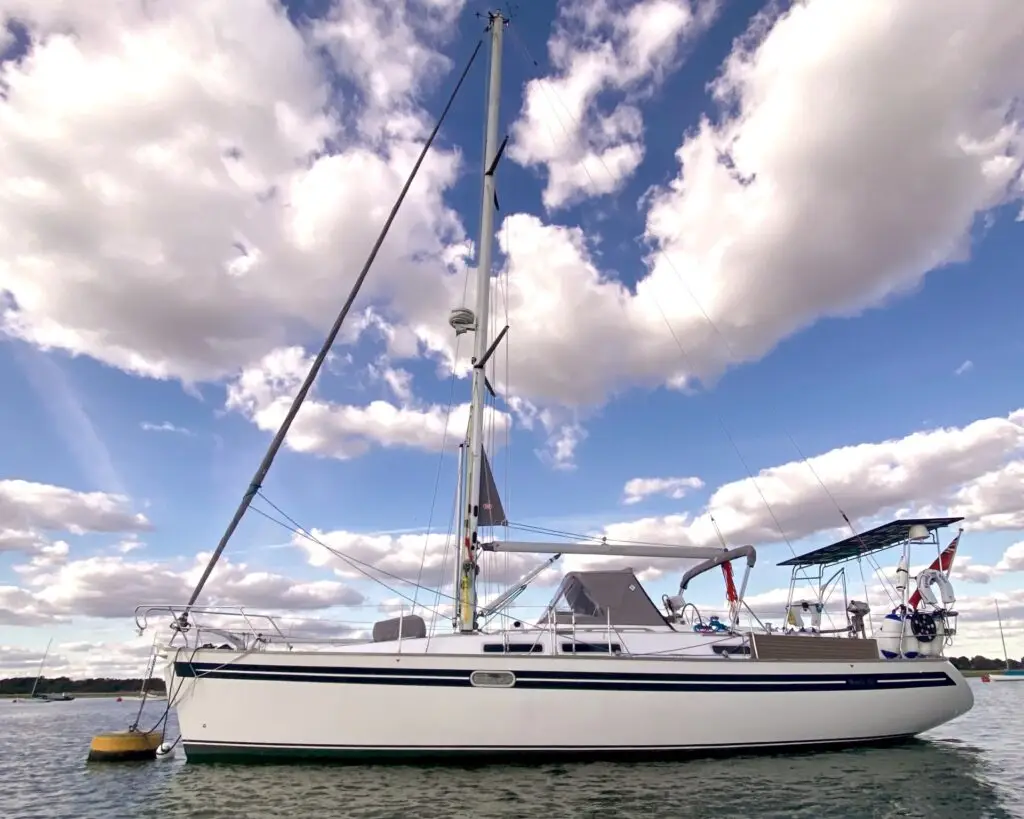
Day to day we use our main sail and our genoa . Our main sail is connected to the mast and furls up within it, technically it is called in-mast furling. Our genoa also furls around our forestay. A Genoa is a sail situated at the front of the boat and is generally large enough to reach back along the boat and past the mast, ours is a big one at 130%, 100% to the mast and 30% past it.
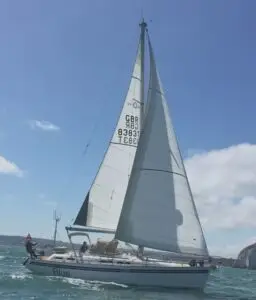
With these two sails we can change the size of the sails to suit the wind strength. In the Caribbean we’ve always sailed reefed due to the strength of the trade winds. The videos below show Yanula Blue using these sails on different points of sail. Look out for Yanula Blue’s old name on the second one!
When the wind is light
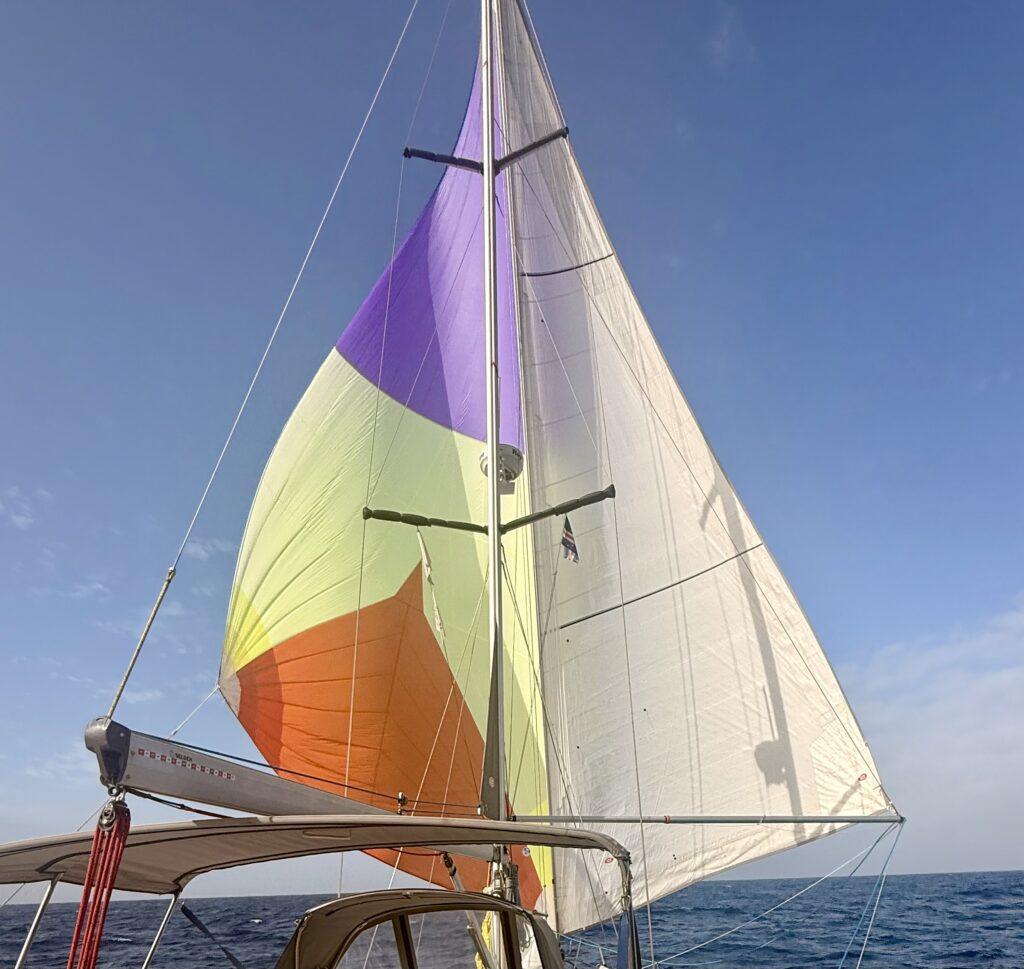
When the wind is light, we struggle to use the heavy dacron sails and so we turn to our Gennaker, a light wind, downwind sail made from a lighter material and cut in such a way that it uses more aerodynamic force from the wind. The sail is not in the colours we would have chosen, in fact we think it might have been made from sail loft leftovers given the colour it is, however it’s a great sail.
We have it mounted on a furling torsion rope and deploy it from the bow forward of the genoa, suspended by the its own halyard (line from the top of the mast used to hold the sail up). We use it in winds below 20 knots and when the wind is greater than 90 degrees to us.
When the wind is heavy
Although we can furl the genoa away when the going gets tough, we also have two extrasails of different sizes we can bring out for different conditions.
Our stay sail is an 80% cut heavy weather sail and so is designed to reduce the aerodynamic force derived from it. It does not furl, but is mounted on a removeable inner forestay that we had installed when we updated the rigging in Portland. The removeable inner forestay gives us some redundancy should the forestay break and it gives us the option to hoist sails on it. The staysail is connected by hanks and is pulled up the stay with another halyard.
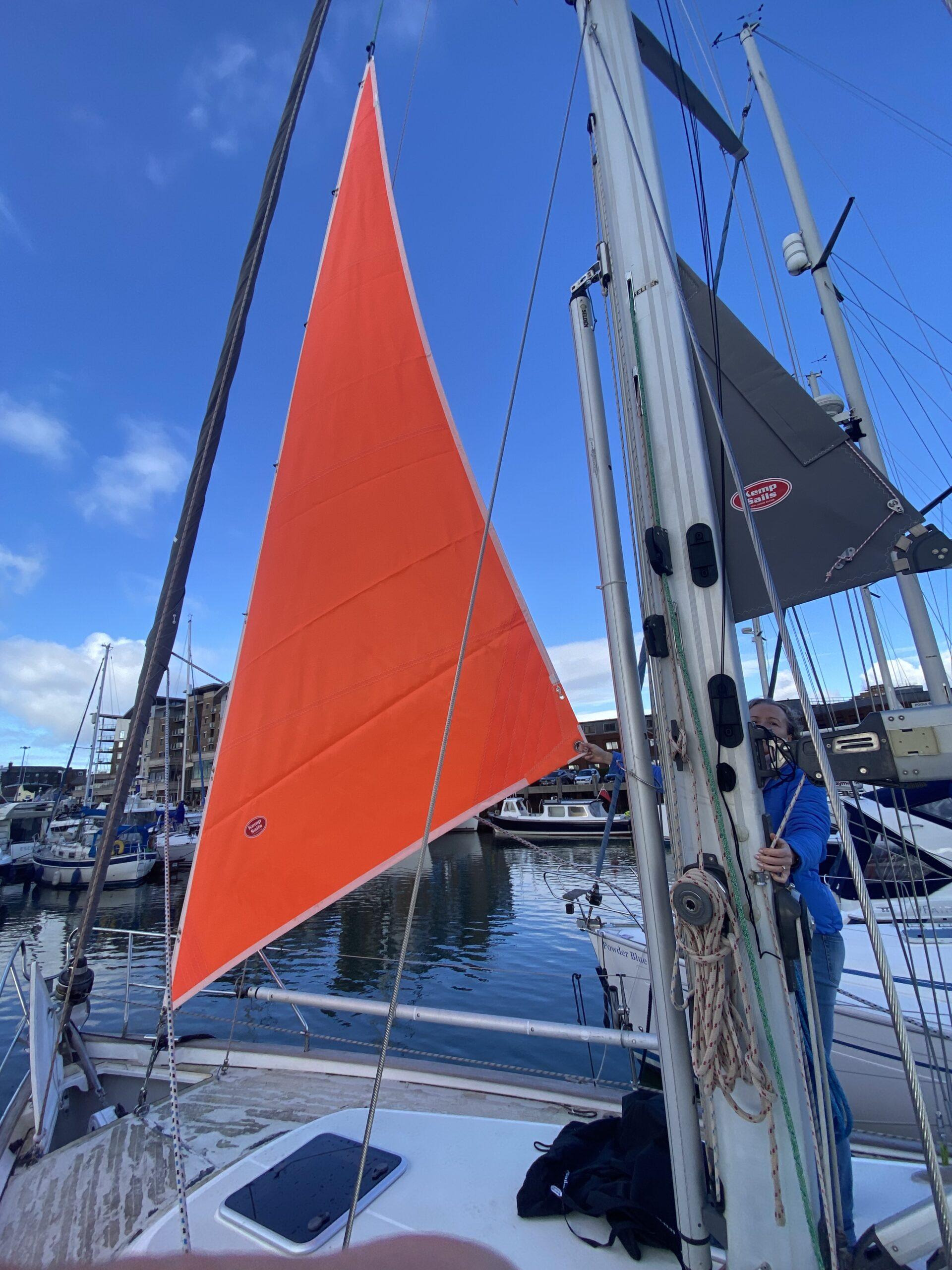
We also carry a storm sail, this is bright orange and significantly smaller than the stay sail and it is designed to be very robust, be carried on our inner forestay and hauled up the stay on hanks with the same halyard as the staysail. We’ve never used it, and hopefully if we get our weather predictions right, we never will.
The Twissle sail
The final sail in our wardrobe is the twissle sail, the sail came with Yanula Blue when we bought her and the previous owner had never used it, however, some internet research led us to a Youtube video by Smacksman1 where he described his Twissle rig set up.
Generally furlers come with two grooves in them and so logically, two sails can be mounted on the same furler. Our twissle sail turned out to be an exact same size and shape as our genoa, albeit in a lighter material, and this meant it could be mounted on the furler together with the genoa and both rolled up together. There were some technical setup additions I needed to add (possibly the subject of another post) but in the main we set it up for our Atlantic crossing.
The rig uses two “floating poles” to maintain the width of the sail and is a downwind configuration, we also learnt that it can be reefed, the poles don’t need to be the same length and it can accommodate wind directions above 140 degrees as shown in the videos below
Other configurations
Now that we’ve established our sail wardrobe we can use the sails in different formats, but before we do, let’s explain using a pole. A whisker pole can be used to push the clew of the genoa sail (the extending corner of the triangle) out so that it can catch the maximum amount of wind whilst sailing downwind. We set ours up independently of the sail so that we can furl our genoa and leave the pole out.
The inner end of the pole connects to the mast and the outer end is suspended from a dedicated line (pole up, good name ha?) and pulled forward and back by dedicated guys that we can adjust from the cockpit.
We use the pole on the side the wind comes from and can combine the poled out genoa with the staysail (stronger winds) or the gennaker (lighter winds).